The Florence issue
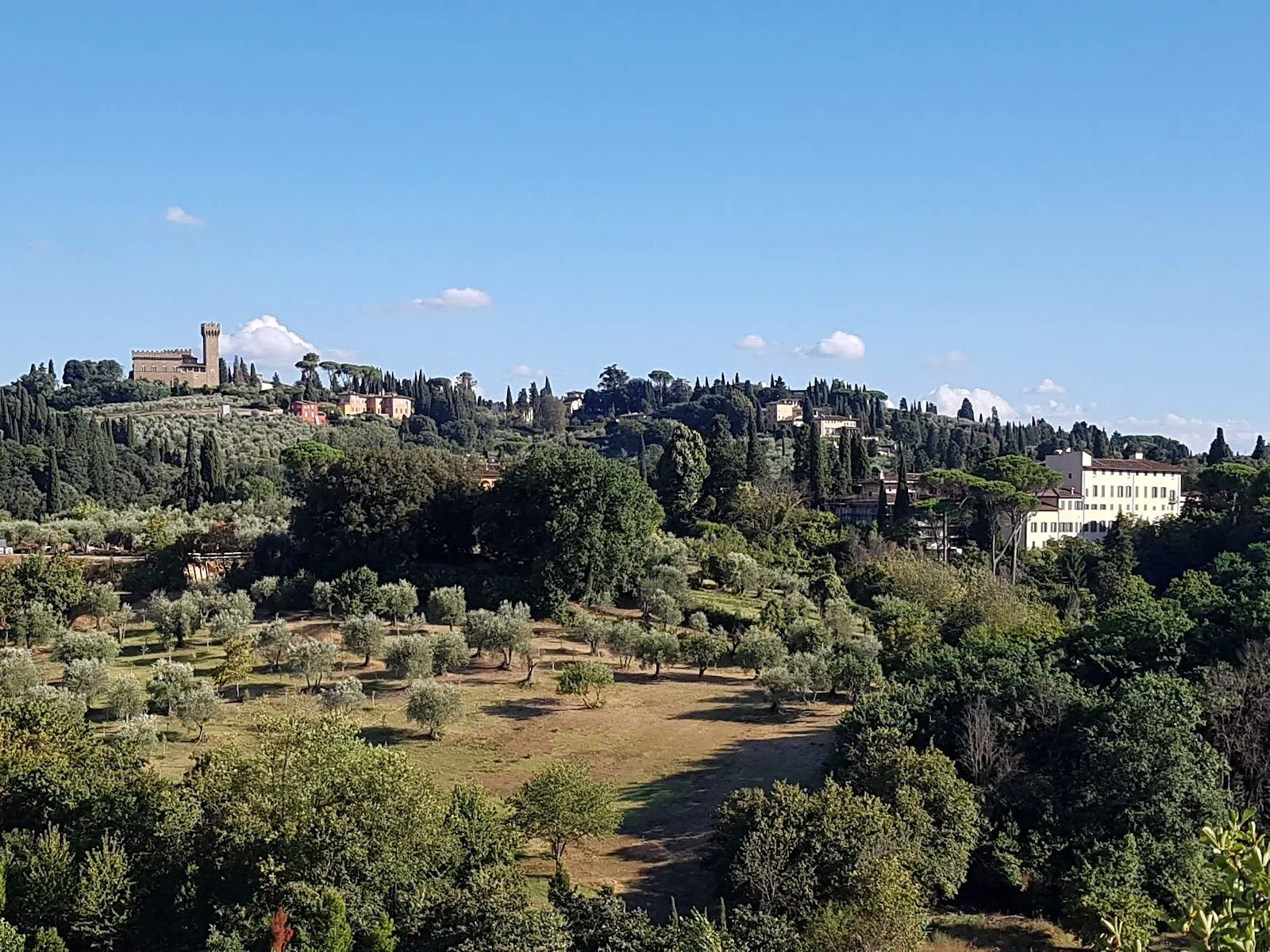
Arcetri and Pian dei Giullari, the olive hill above Florence
Galileo's villa, a working 1872 observatory, two Romanesque churches and one trattoria with a view, on the walled lanes that climb out of Florence.

By Élodie FournierFlorence beyond the Uffizi queue
Galileo lived under house arrest in a plain ochre farmhouse-villa on the Arcetri ridge until his death in 1642, and wrote the Two New Sciences there. The house opens for €6 on a short list of booked dates, clustered in summer. A working observatory founded in 1872 sits further along the same lane, and the lane itself runs out into olive terraces with the Duomo still in sight.
Walking up Via di San Leonardo
Give the climb from Porta San Giorgio 10 minutes. Via di San Leonardo (Porta San Giorgio to Arcetri) is a stone-walled country lane barely wider than a car, with high rendered villa walls on both sides and olive branches and cypress tops spilling over them. Shade falls in patches for most of its length, and an iron gate now and then opens onto a glimpse of a villa garden. It is often called the loveliest street in Florence, and Tchaikovsky lodged on it. The lane is public, free and open at any hour; it is also single-track with no pavement, so listen for cars.


Behind a high wall of olive trees and cypresses on the same lane, Chiesa di San Leonardo in Arcetri (Via di San Leonardo) shows a plain gabled front and a single bell arch. It was founded in 1001 and stripped back to its Romanesque bones in the 1890s. The 12th-century pulpit inside is inlaid in black and white marble, and local legend has Dante and Boccaccio preaching from it. Entry is free; arrange visits outside Mass in advance by phone (+39 055 223084). Keep the party under a dozen, because a coach group will not fit the building.
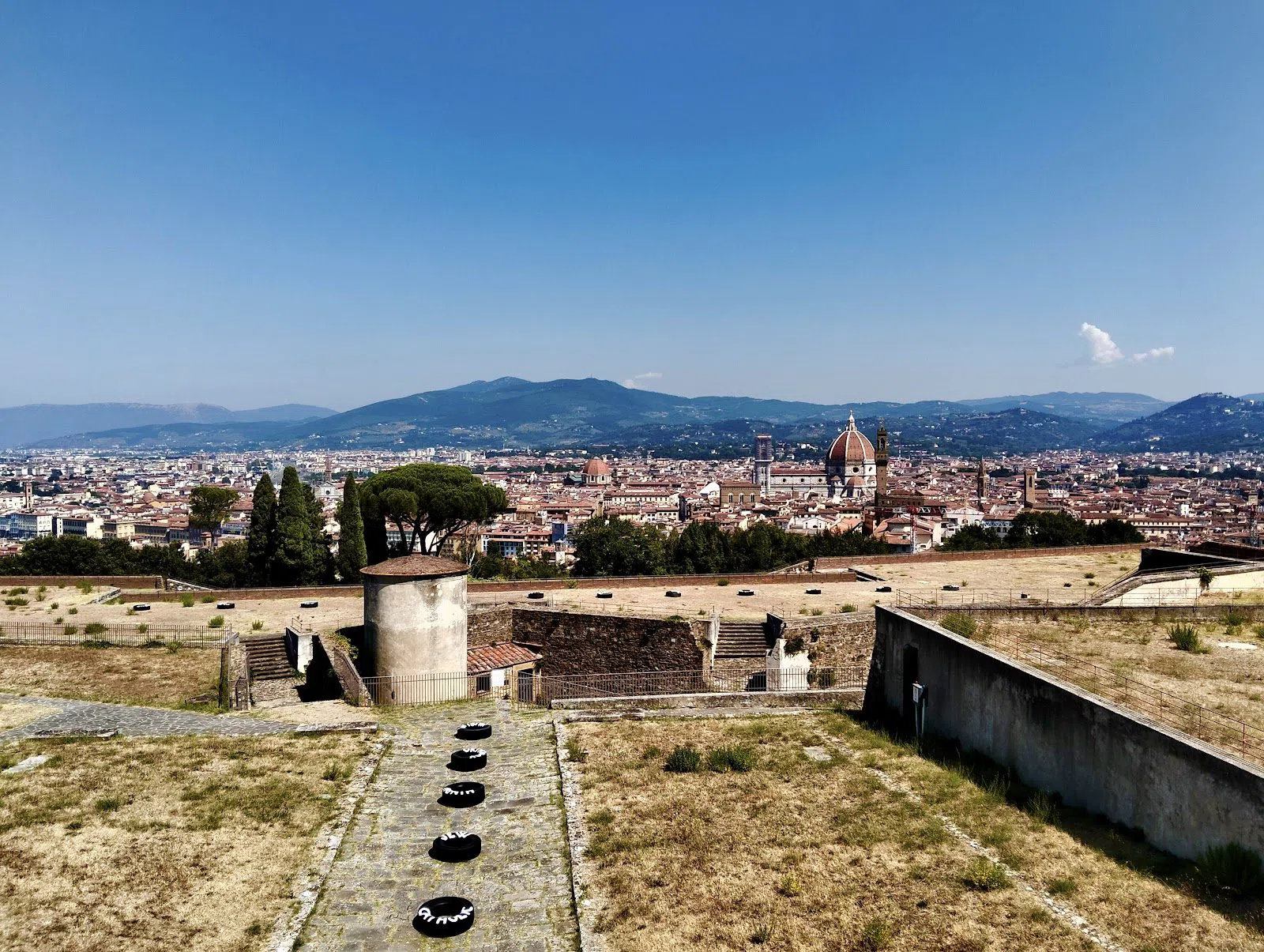
Forte di Belvedere (top of Costa San Giorgio) is Buontalenti's fortress of the 1590s and the gateway to the Arcetri lanes, star-shaped, its sloping stone bastion walls set around a white Mannerist palazzina. The wide grass ramparts double as an open-air sculpture terrace, and the view from them runs the full 360 degrees over the city. Whether you get in at all depends on the season. The 2026 opening runs 24 June to 16 October, Tuesday to Sunday, 10:00 to 20:00, and the gates are locked for the rest of the year. Guided tours run Friday, Saturday and Sunday at 17:00 and 18:30, and the café stays open to 23:00 from Wednesday to Sunday. Entry has been free in some seasons; otherwise you pay for the exhibition ticket (€€).
Plan your Florence trip
Live prices from our booking partners.
Free cancellation on many rooms. We may earn a commission when you book.
Galileo's house and the observatory on Pian dei Giullari
Villa Il Gioiello, also signposted as Villa Galileo, sits in Arcetri behind a low stone wall on a narrow lane, green shutters under a shallow tiled roof and the olive terraces dropping away to the city behind it. The rooms are bare and vaulted, with a loggia and a small walled garden. Visits are by guided tour only, in small fixed-size groups, and booking is mandatory. Entry is €6 full and €3 reduced, and some special openings are free. Book private and school groups ahead by phone or email. Walk-ups are turned away and the open dates are few, so fix your slot before you plan anything else on the hill.

Osservatorio Astrofisico di Arcetri (Via del Pian dei Giullari 16) is a 19th-century pale-stucco block under a white hemispherical dome among the cypresses, with a pine astronomical park around it. It was founded in 1872 and still works as a research institute. On the 'Osservatorio Aperto' openings, held monthly by day and in the evening for adults, you stand under the open dome slit and look through the brass-and-black Amici refractor on its cast-iron mount. The public programme runs from mid-October to late May, with the 'Notti d'Estate' nights in summer. Reserve in advance through Eventbrite or at [email protected]; school groups book separately. Most public openings are free with a booking, and some evening events charge a fee. Check the dates before you walk up to the gate.

Torre del Gallo (Via della Torre del Gallo) stands alone on the crest above the olive groves, square and crenellated, a jutting machicolated crown at the top and a Renaissance-style loggia at its gate, the whole of Florence laid out below. Stefano Bardini rebuilt it in the 1900s as his own fantasy of a medieval tower. Its association with Galileo's stargazing is legend. The tower is private property with no interior access, and any tour promising you inside cannot deliver it. The lane and the ridge view cost nothing.
Santa Margherita a Montici and San Miniato al Monte

Chiesa di Santa Margherita a Montici gives the Montici lane its name. It was built in 1135 as a fortress and consecrated in 1240, and the massive crenellated tower of that fortress now carries the bells. A balustraded terrace on four columns, with two large statues between them, looks straight down the Arno valley, and the panorama is free with almost nobody on it. Count on the church being open around the 11:00 Sunday Mass, and take the terrace afterwards. The approach lane is single-track and parking is near-impossible, so come on foot and in small numbers.

Basilica di San Miniato al Monte sits a five-minute walk from the bottom of the Arcetri hill road, its green-and-white geometric marble facade and the gold mosaic of Christ in its gable crowning a long flight of steps. Inside, a raised choir stands over the crypt, above an inlaid zodiac marble floor and under a gilded coffered ceiling. Entry is free and needs no booking, and the basilica closes to visitors during services. Hours are Monday to Saturday, 09:30 to 13:00 and from 15:00 or 15:30, and Sunday from 08:15. Build the end of the afternoon around vespers: the monks sing Gregorian chant, unaccompanied, every afternoon for half an hour, at 17:30 in summer and 17:00 in winter.
Piazzale Michelangelo and the rose garden below it
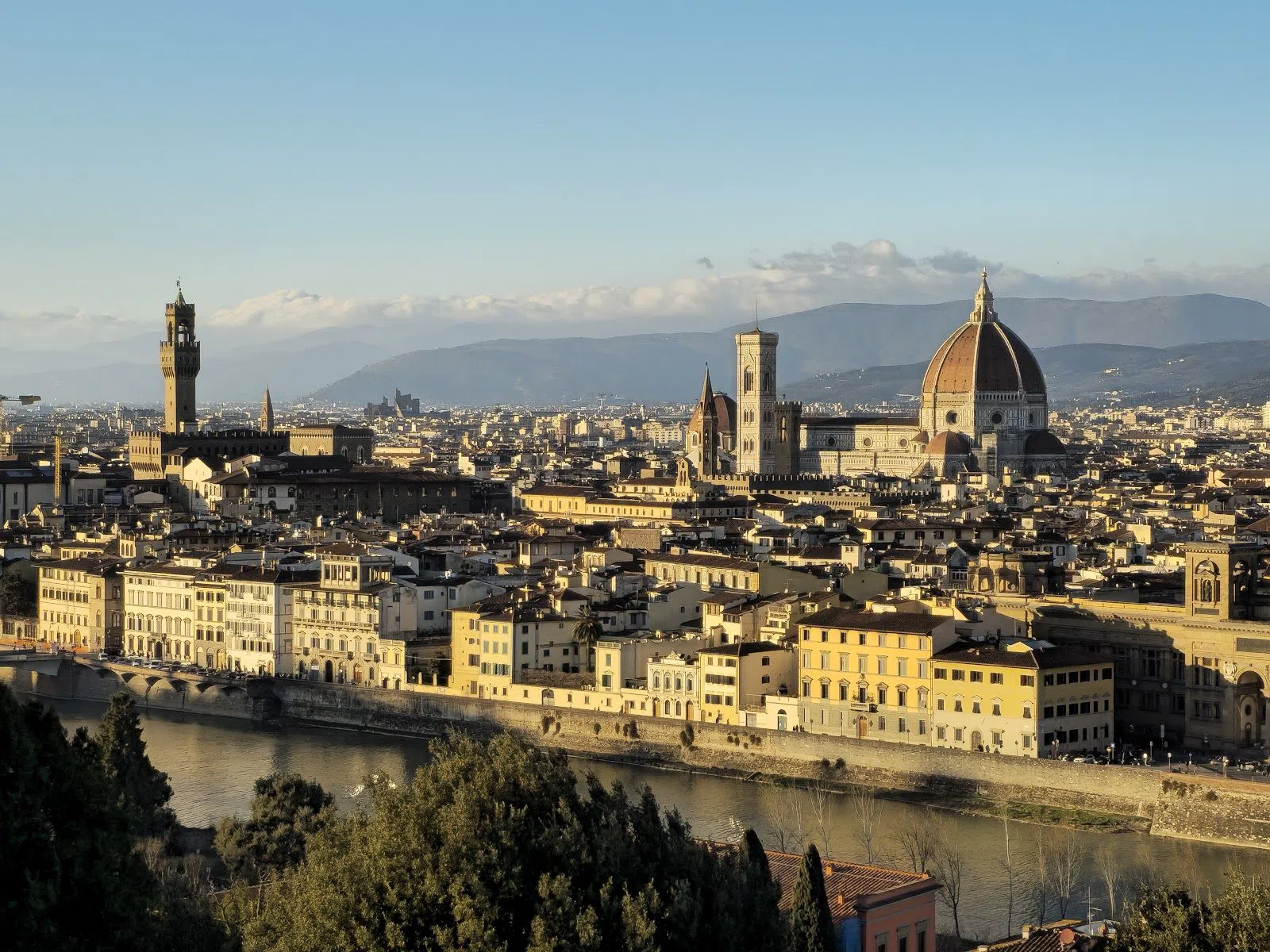
Piazzale Michelangelo is Giuseppe Poggi's terrace of 1869, a wide stone-balustraded platform with a bronze copy of Michelangelo's David on its plinth, the Arno and its bridges strung out underneath and the Duomo's red dome dead centre on the skyline. It is free and open at all hours. Most coach groups stop here, so come early in the morning or after dark. Viale Galileo leaves the square and climbs into the quiet villa lanes.
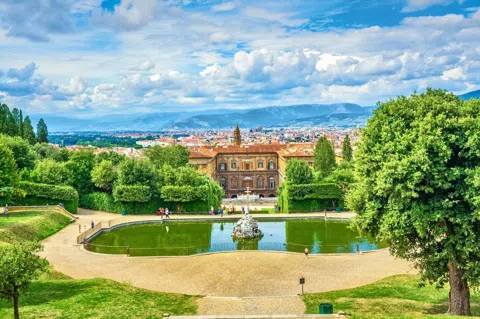
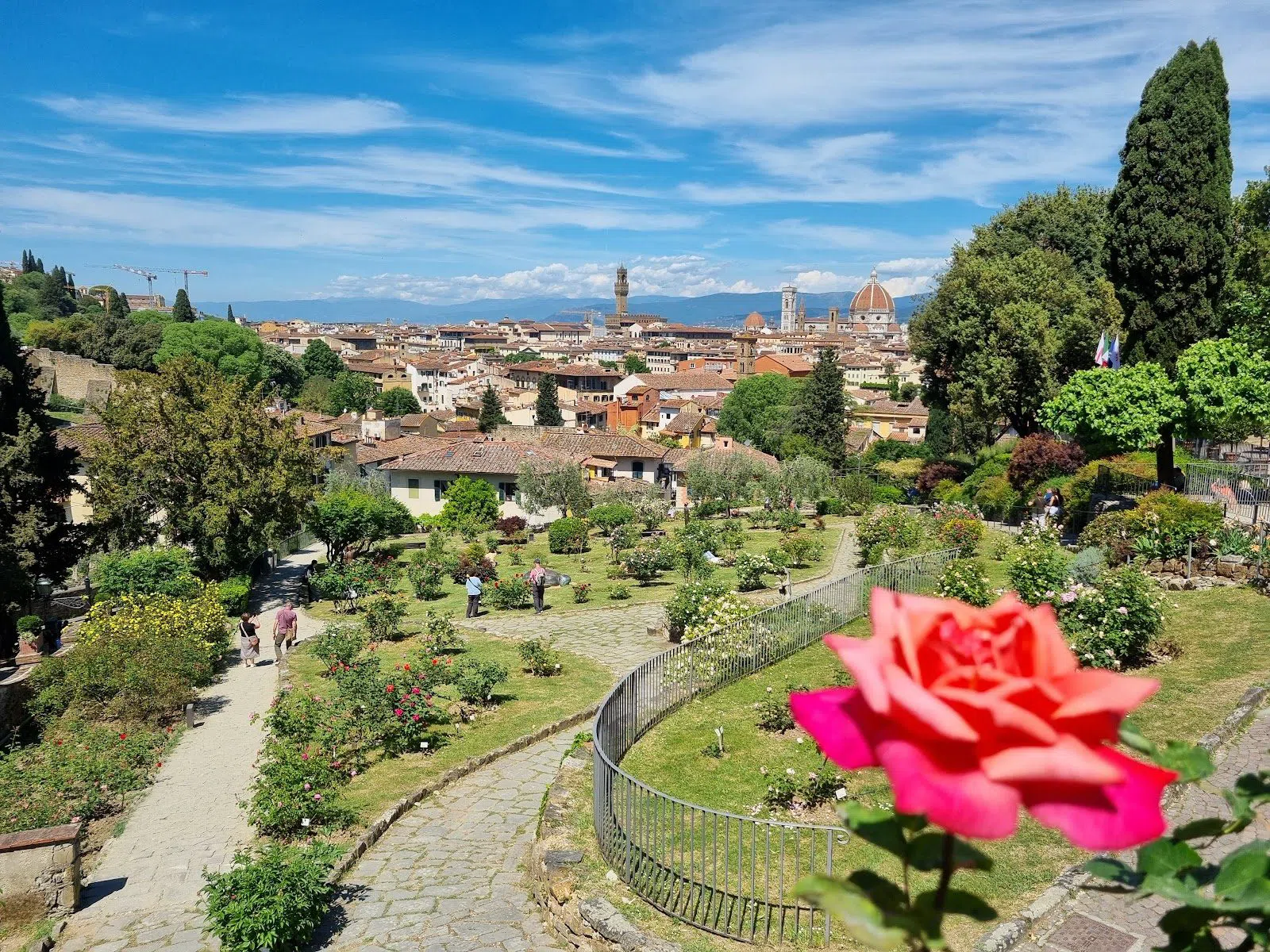
Giardino delle Rose steps down the hillside directly below that terrace, more than 400 rose varieties on narrow gravel paths, a small Japanese shoin garden, and a dozen dark bronze Jean-Michel Folon figures set among the beds with the Duomo framed behind them. It is free and unticketed, open daily, 10:00 to 20:00 from June to September, 10:00 to 18:00 in October and November, and 10:00 to 17:00 from December to May. Peak bloom is May. The bronzes and the view carry the detour in the other months.
Eating and drinking on the hill
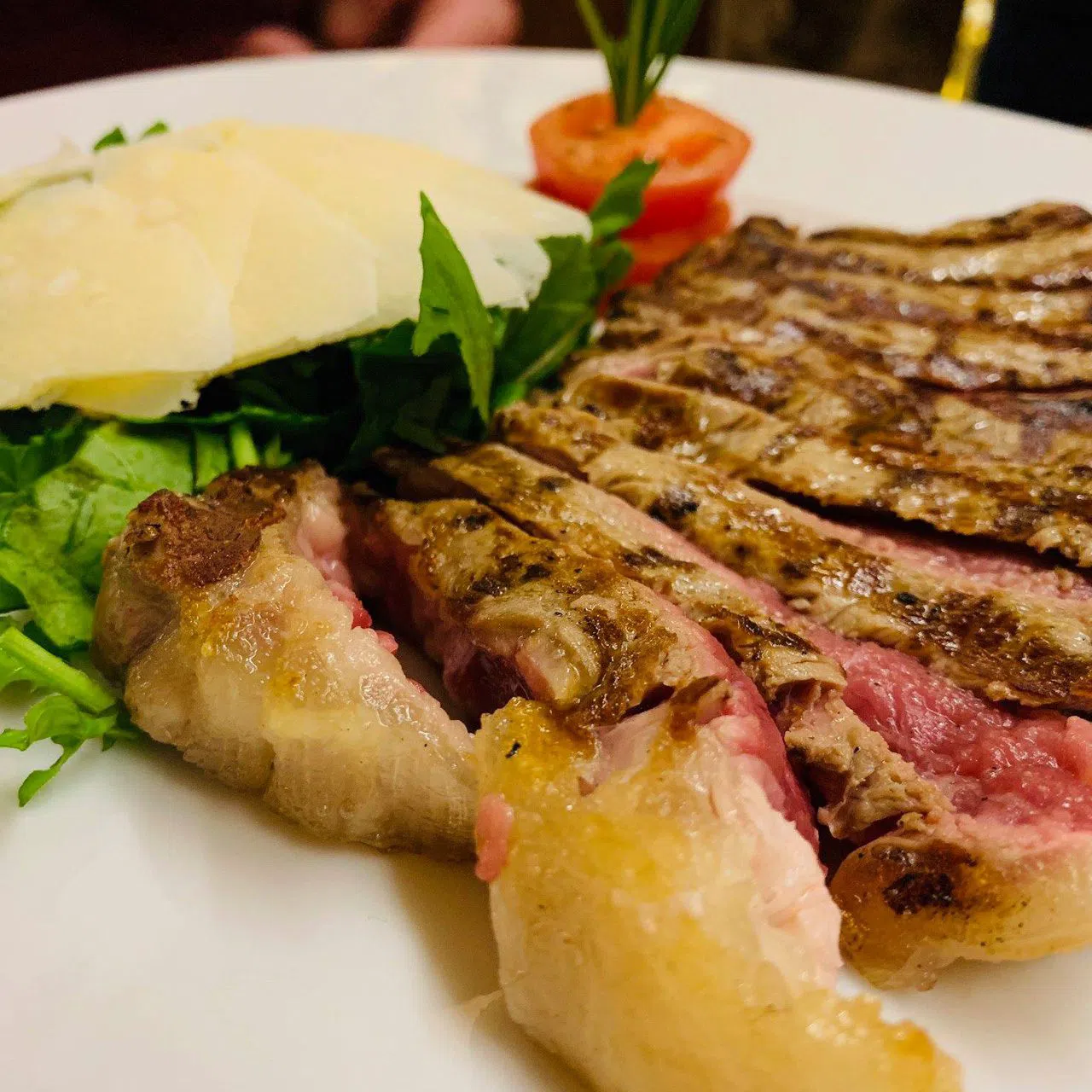
Trattoria Omero stands directly opposite Galileo's villa in Arcetri, held by the same family for decades. You come in through a working alimentari hung with hams and jars, then out into a bright glassed-in dining room and, in summer, onto the terrace with the whole of Florence spread below. The bistecca is grilled over wood and the pasta is made by hand, and the cellar lists more than 200 wines. Expect €40 to €55 a head with wine. Service runs daily, 12:15 to 14:30 and 19:30 to 22:30, though some listings show Tuesday closed. Reserve, because the room is small and the kitchen is well known.
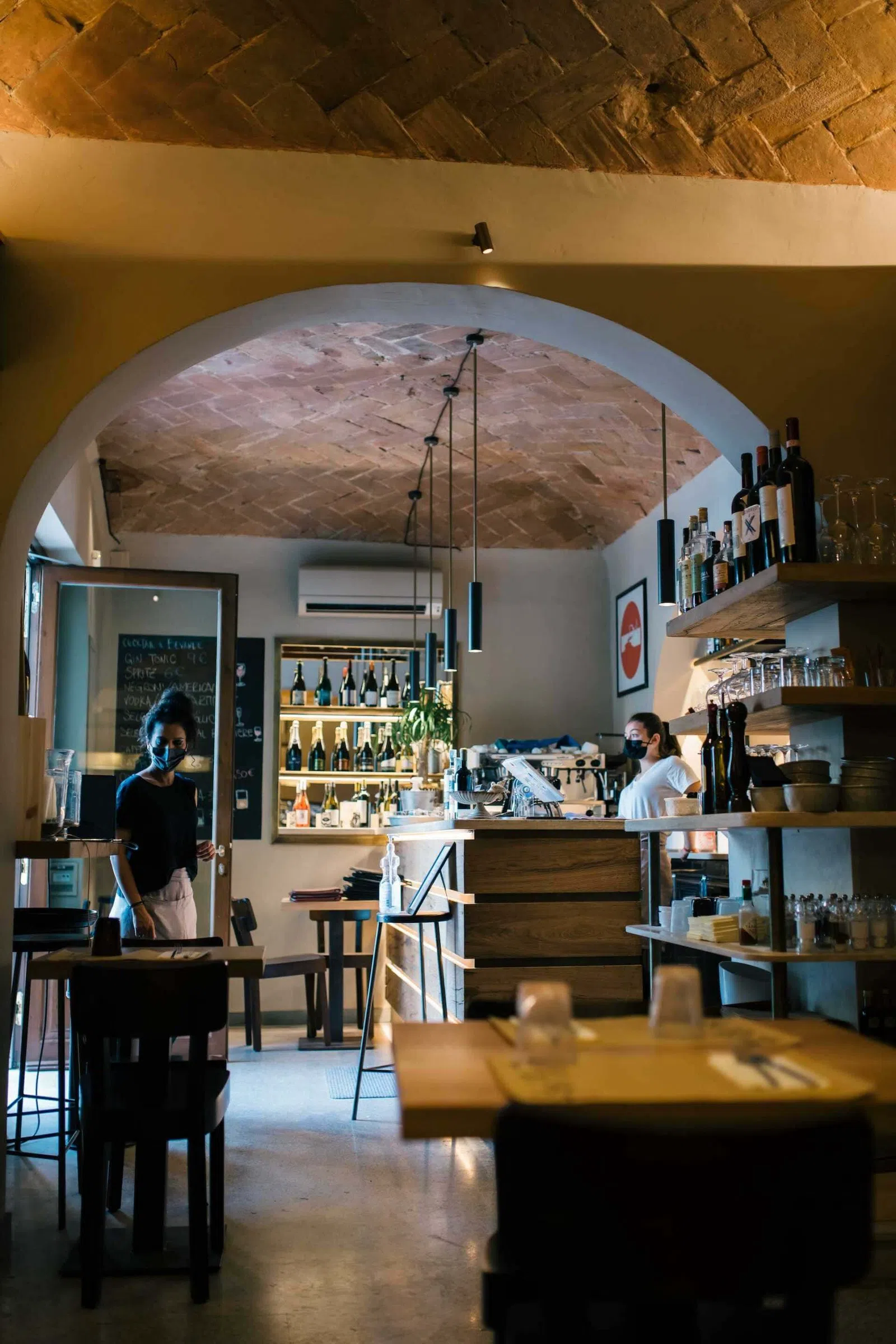
EnotecaBar Fuori Porta has been open since 1987 at the foot of the hill road, under the medieval Porta San Miniato arch, with a small street terrace beneath it. The room behind is dark and wood-panelled, lined floor to ceiling with bottles and blackboard lists. The bar pours more than 200 Italian labels by the glass, and the crostoni made the house name. Reckon on €25 to €35 a head. It opens Tuesday to Friday, 12:00 to 15:30 and 19:00 to 23:30, and Saturday and Sunday, 12:00 to 23:30. It closes Monday, which puts it at the start or the end of a hill walk on any other day.

La Loggia del Piazzale Michelangelo has traded since 1876 in Poggi's own building, tall arched openings and a colonnaded panoramic terrace set on the edge of the square, white-linen tables facing the Duomo. It opens daily, 11:00 to 23:00. A meal costs €70 to €100 a head, a clear premium for the terrace. Book a sunset table, or take a coffee at the café side. The terrace takes private dinners, weddings and large parties on request.
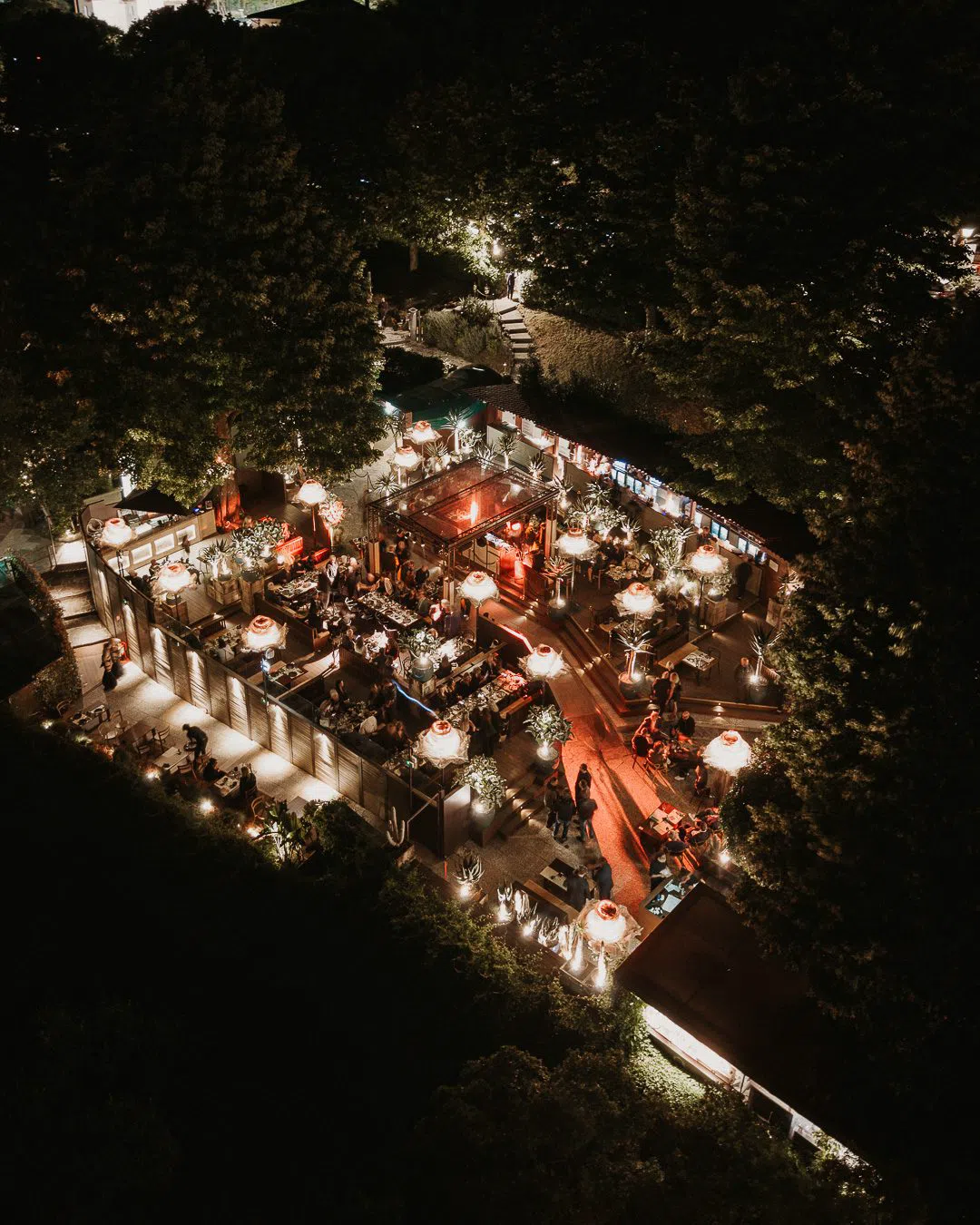
Flò Firenze (Viale Michelangelo) relaunched for 2026 under new management as a 'Botanical Terrace', an open-air deck wrapped in dense floral installations and strung lighting, with a DJ booth, a long bar and the lit skyline directly below the railing. Aperitivo runs into dinner and then into late clubbing. The season is mid-May to September and the terrace is shut for the rest of the year. Cocktails are €15 and dinner costs more. Book a table for dinner; after that, the standard club door applies.
Where to stay above the city

Art Hotel Villa Agape (Via Torre del Gallo) is the one real hotel inside the neighbourhood, a pale 16th-century villa (the old Villa Arrighetti) with shuttered windows and a stone loggia, standing in a formal Italian-garden park of clipped box, olives and cypresses. The city view is from the terrace. It has 31 rooms including suites. Parking is free, the shuttle to the centre is free, and pets are welcome. Rooms start at €120 a night and cost considerably more in high season. Take the hill's quiet and use the shuttle, or walk down.
Hotel Villa Belvedere Firenze (Via Benedetto Castelli) is a low white villa of the 1930s just over the ridge from Arcetri, a shaded veranda along its front, an outdoor pool ringed with sunbeds and a tennis court, cypresses framing it on the Poggio Imperiale slope and the Duomo visible across the garden. The street carries the name of one of Galileo's pupils. The Ceschi-Perotto family run the house, and parking is free. It has 26 rooms, 21 of them double or twin, with two singles and three suites. Rates run €150 to €280 a night by season. It suits families and small parties, and the pool is the practical argument for it in summer heat.

What to book and what is closed
Villa Il Gioiello and the observatory open only on set dates and both need a booking, and San Leonardo opens by phone arrangement. Forte di Belvedere and Flò Firenze close outside their summer seasons, Fuori Porta closes Monday, and San Miniato shuts to visitors during services.
See the Florence guide and the Florence hotel search.
Before you go
Can you go inside Galileo's house in Arcetri?
Yes, but only on a guided tour, booked in advance. Villa Il Gioiello costs €6 full and €3 reduced, some special openings are free, and it opens on a limited set of dates clustered in summer. Phone or email to arrange private and school groups. Turn up without a booking and they will send you away.
How do you walk up to Arcetri from the city?
Via di San Leonardo is the proper way in, 10 minutes up from Porta San Giorgio and then out into olive-grove country. It is a public road, free at any hour, single-track with no pavement, so listen for cars as you climb.
Can the public look through the telescope at the Arcetri observatory?
Yes. The 'Osservatorio Aperto' openings at Via del Pian dei Giullari 16 come round monthly, by day and in the evening for adults, and you look through the Amici refractor under the open dome slit. The season is mid-October to late May, plus the 'Notti d'Estate' summer nights. Book through Eventbrite or at [email protected]; most openings are free if you book, and some evening events charge a fee.
Is Forte di Belvedere open all year?
No. In 2026 it opens 24 June to 16 October, Tuesday to Sunday, 10:00 to 20:00, and it is locked outside those dates. Guided tours run Friday, Saturday and Sunday at 17:00 and 18:30, and the café serves to 23:00 from Wednesday to Sunday.
Where do you eat on the Arcetri hill?
Trattoria Omero is the one proper restaurant in Arcetri, directly opposite Galileo's villa, at €40 to €55 a head with wine; reserve, as the room is small. At the foot of the hill road, EnotecaBar Fuori Porta pours more than 200 Italian labels by the glass for €25 to €35 a head and closes Monday.